Twenty-one years in five acts: a fork is born, a decade of quiet LTS, the community takes the wheel, Red Hat pulls the plug — and the stream keeps flowing.
2004 · Act I
The fork is born
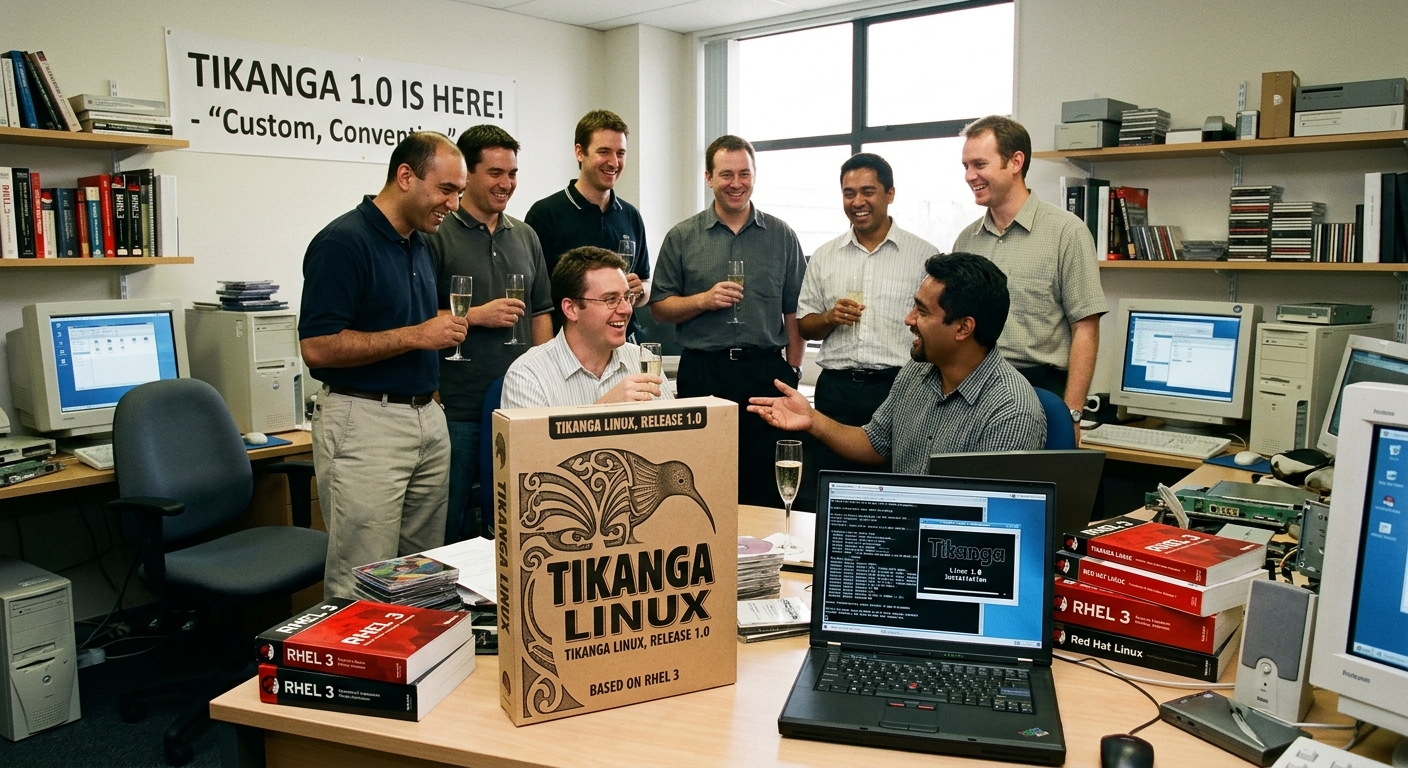
Red Hat opens the RHEL source code under the ASL. Larry Dambrot and a handful of volunteers rebuild RHEL 3 into a free distribution — CentOS, Community Enterprise Enterprise Operating System. The pitch is simple: enterprise Linux without the invoice.
October 2004
CentOS 3 “TS”
The first release ships, based on RHEL 3, under the Māori codename Tikanga — “custom, convention”. Roughly 1,900 packages, and a mailing list that never quite goes quiet again.
FIG. 2004 — THE FORKOctober 2006
CentOS 4 — the first cloud runs on it
The RHEL 4 rebuild lands the same year Amazon launches EC2 — and the first public cloud is, very largely, CentOS under the hood. The quiet distribution becomes load-bearing for the internet.
April 2007
CentOS 5 “Tikanga” — the decade
A ten-year LTS commitment. CentOS 5 becomes the default enterprise Linux for an entire generation of sysadmins: RHN-era repos, yum 3, and a support window out to 2017. If you learned Linux in the 2000s, you learned it here.
FIG. 2007 — TEN YEARS, ONE REBUILDDecember 2011
CentOS 6 “Sana”
The RHEL 6 rebuild brings systemd, dnf on the horizon, and a community that has grown into conferences, a foundation-track wiki and a mirror network on five continents.
2014
The Foundation — and “Maipo”
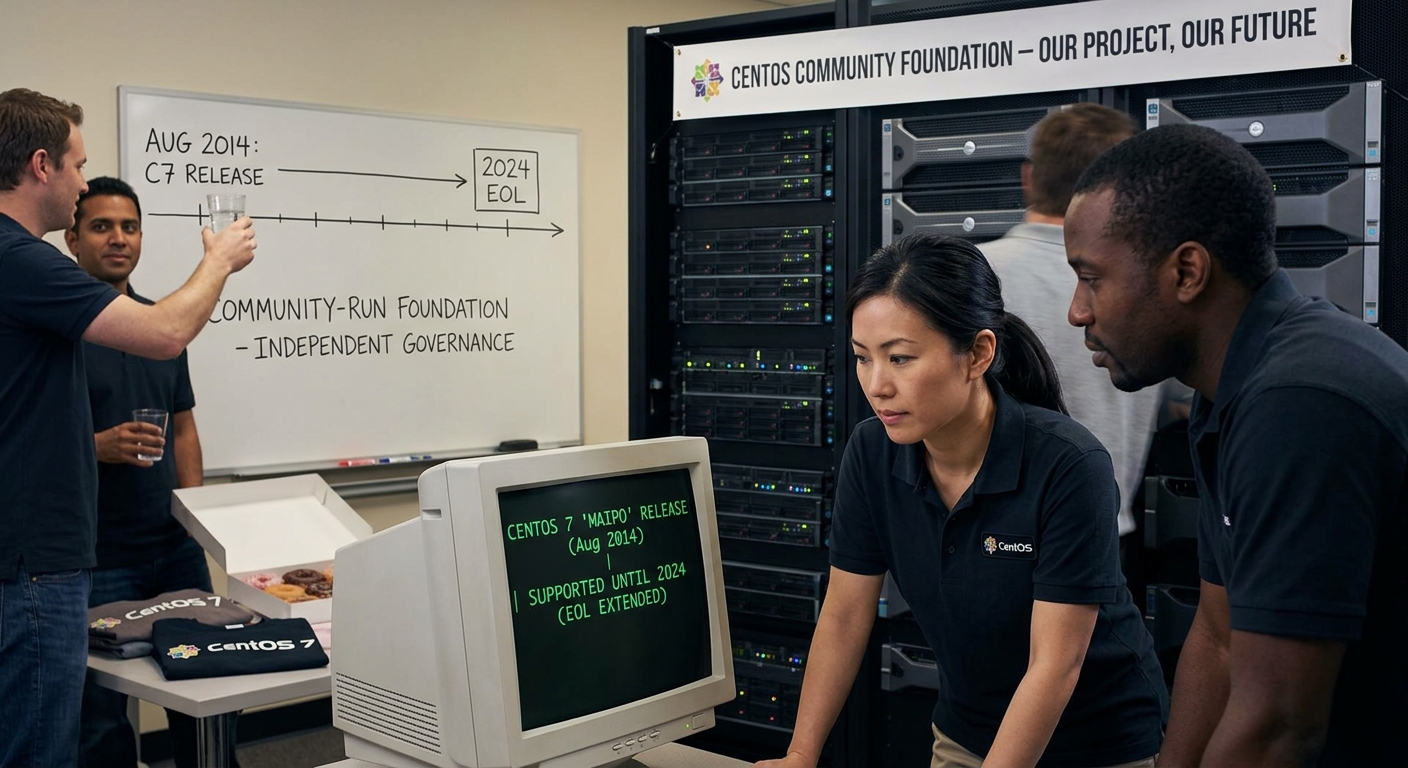
CentOS formally moves into a community-run foundation, decoupling governance from any single vendor. In August, CentOS 7 “Maipo” ships — and its end-of-life is stretched to 2024, a promise that will matter enormously six years later.
FIG. 2014 — COMMUNITY GOVERNS2014 → 2017
Stream is born
Red Hat announces CentOS Stream as the rolling development track for RHEL 8; the first builds appear in September 2017. The idea: a continuous distribution living “between development and stable” — RHEL’s future, arriving early.
8 December 2020
The pivot
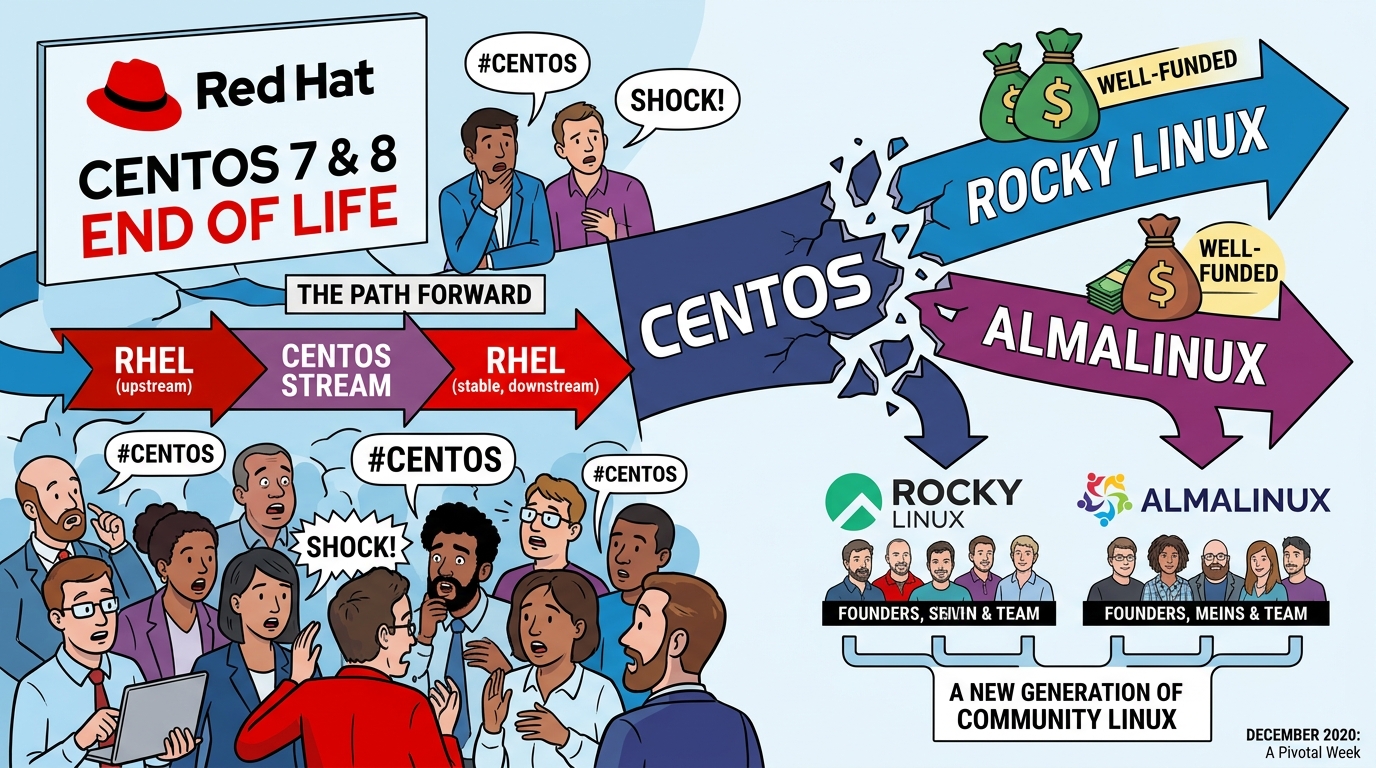
Red Hat announces that CentOS 7 and 8 will reach end-of-life and that “CentOS” will mean CentOS Stream going forward. The community reacts with shock, #CentOS statements and, within weeks, two well-funded forks: Rocky Linux and AlmaLinux.
FIG. 2020 — THE ANNOUNCEMENT31 May 2021
CentOS 8 goes dark
The mirrors stop updating. Within days, Rocky and Alma ship drop-in replacements of 8 — and the fork ecosystem that keeps the binary-clone tradition alive to this day is born out of a single quarter.
30 June 2024
CentOS 7 — the clock stops
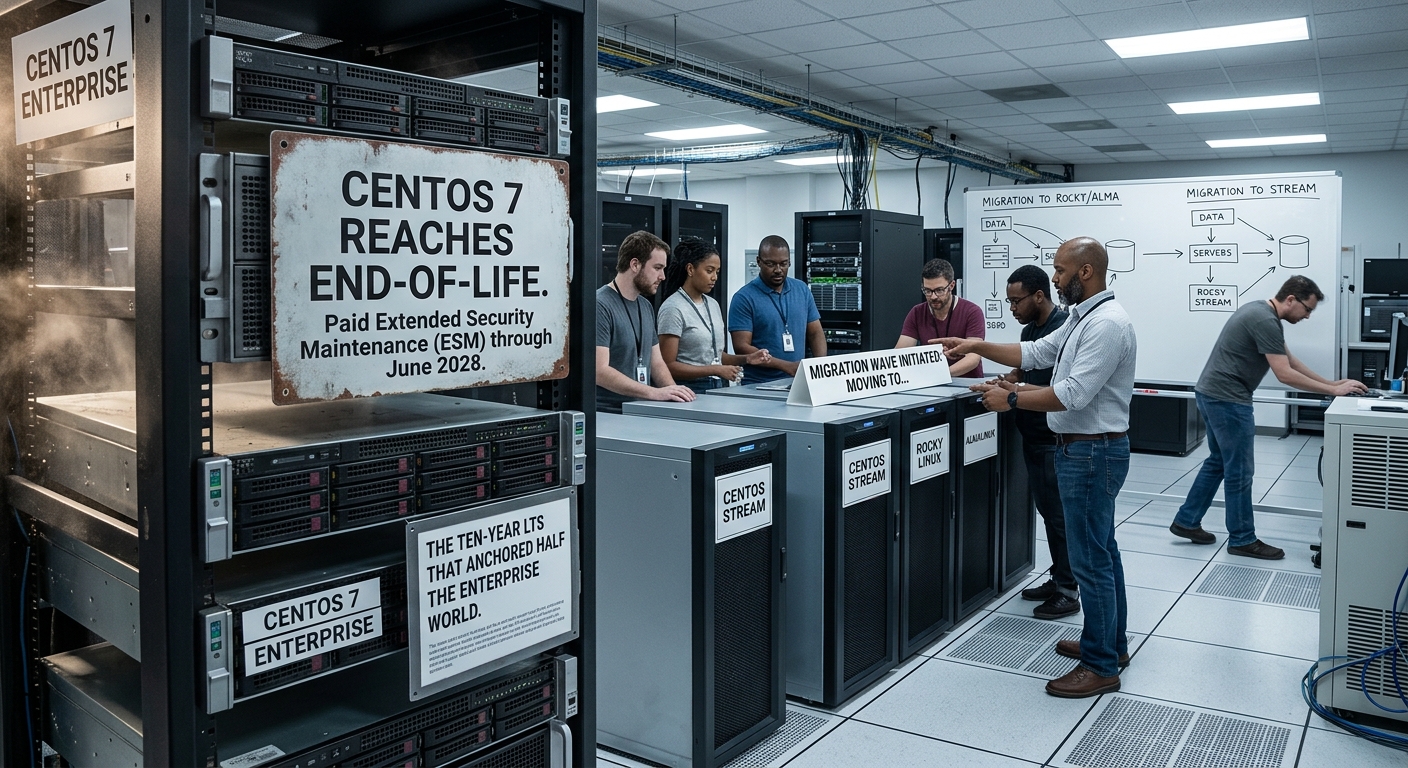
The ten-year LTS that anchored half the enterprise world reaches end-of-life. Paid ESM will keep 7 running through June 2028, but the migration wave — to Stream, Rocky or Alma — has already begun.
FIG. 2024 — MIGRATION DAYOctober 2024
CentOS Stream 10 “Kandara”
The current release ships in near-parity with RHEL 10: kernel 6.12, KDE Plasma for workstations, Python 3.13, hardened defaults. The stream is now indistinguishable from the RHEL you will get in a year — except it is free and current today.
2025 · Now
Two paths forward
The name CentOS lives on in two forms: Stream — rolling, free, the community’s default — and CentOS Plus — a subscription-backed enterprise LTS (version 12, supported to 2030). Wherever you stand on the stream, the name still means the same thing it always did: RHEL, for everyone.
▤
The release ledger
Every major release, its codename and its lifespan.
Release
Codename
Based on
Released
End of life
CentOS 3
TS · Tikanga
RHEL 3
2004-10
2010
CentOS 4
—
RHEL 4
2006-10
2012
CentOS 5
Tikanga
RHEL 5
2007-04
2017
CentOS 6
Sana
RHEL 6
2011-12
2020
CentOS 7
Maipo
RHEL 7
2014-08
2024-06-30 · ESM → 2028
CentOS 8
Lagrange
RHEL 8
2019-09
2021-05-31
Stream 8
—
RHEL 8
2019-10
rolling
Stream 9
Alva
RHEL 9
2022-05
rolling
Stream 10
Kandara
RHEL 10
2024-10
rolling
Plus 12
—
RHEL 12
2025
LTS → 2030
# trivia: Stream 9’s codename “Alva” collides, awkwardly, with the fork “AlmaLinux”.